October 2025 · Interactive Media Capstone

Kinetic Ellipse

A prototype for dynamic, responsive, living architecture — composed through movement.

Role: Computational designer · Processing developer

Concept & Inspiration

An Encounter with Jenny Hall

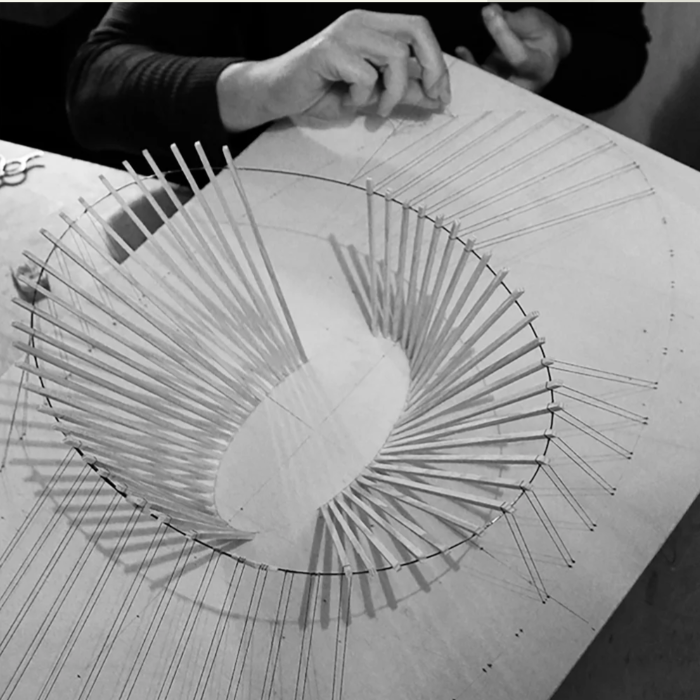
The idea for Kinetic Ellipse began at Sound Kitchen in Sharjah, where I participated in a live demonstration of Magnesynth with Professor Michael Ang. Following the performance, I met Jenny, an architect from Wales. After sharing that my capstone explored the idea of interactive architecture, she was intrigued and shared her website with me. What really caught my attention on her website was Proto Elips because featured an elliptical arrangement of slanted wooden columns that looked as though they were held together parametrically by some mathematical formulation.

So naturally, I thought to myself, "What if I could make Proto Elips interactive, responsive, or dynamic?

I began imagining potential interesting results that could be achieved if the columns could rotate independently, responding to one another and changing the character of the space they enclosed. Rather than treating architecture as a fixed arrangement of materials, I wanted to explore it as something dynamic: closer to a living system than a static object.

Thus was born Kinetic Ellipse, a project developed while I was working on my Interactive Media Capstone. It became a prototype of the idea or responsive architecture/spaces: not a finished building, but a computational experiment into how architecture might perform, respond, and transform over time.

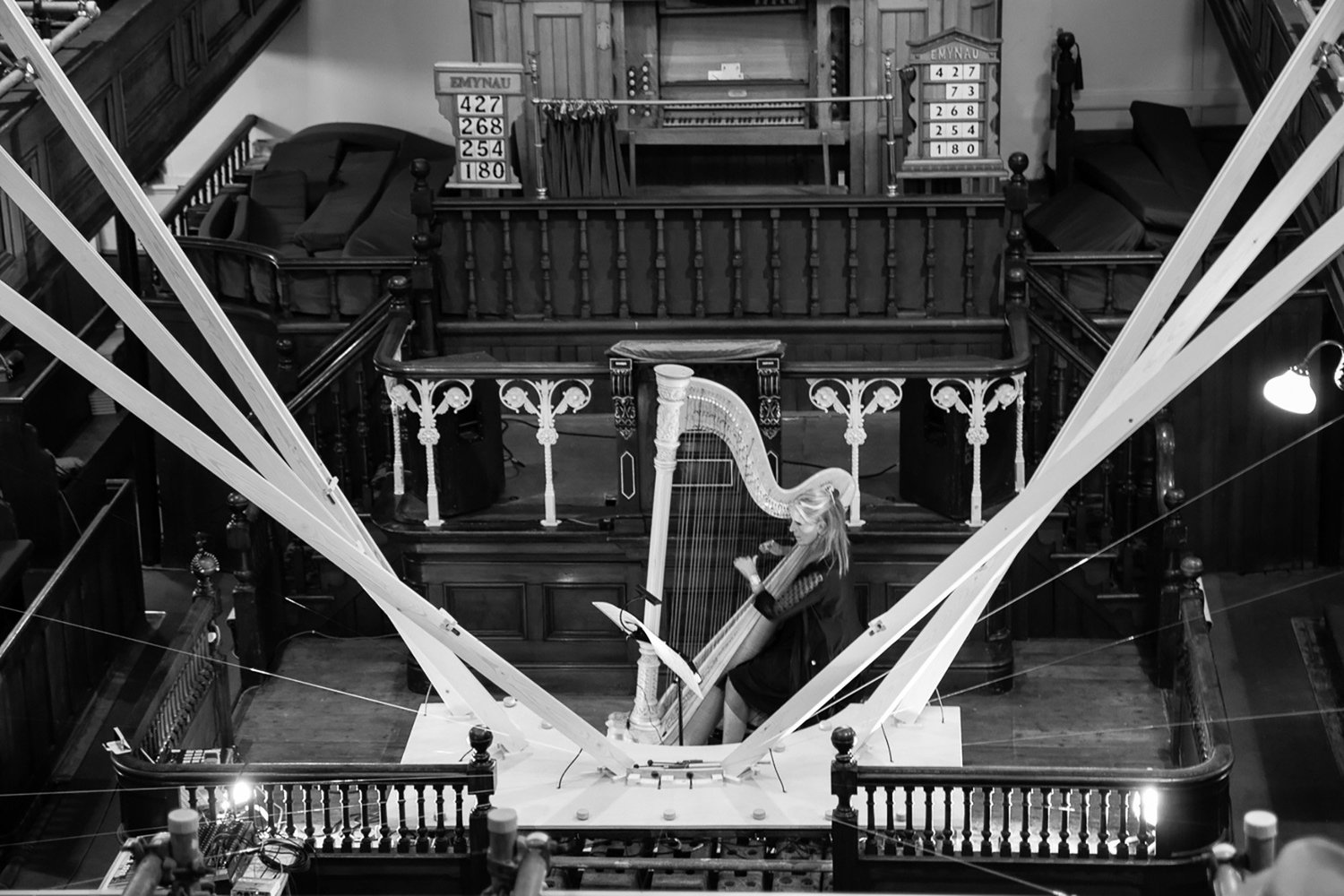
Proto Elips installation with a harpist performing inside The Tabernacl
Proto Elips, Crafted Space — Culture Action Llandudno, 2016
Visitors interacting with Proto Elips slanted columns
An architecture meant to be inhabited and played

Photos: Lindsey Colbourne & Llawn 04 · Source: craftedspace.co.uk/artworks/proto-elips

Development Process

Four Iterations Toward Motion

The development of Kinetic Ellipse progressed through four iterations, from a parametric 3D model to a kinetic system capable of communicating with physical hardware. Each stage allowed me to investigate how independently controlled columns could collectively transform architectural space.

Parametric Ellipse & Sequential Motion

I began by using Processing (Java) to arrange 40 columns along an elliptical perimeter. Rather than positioning each column manually, I used parametric equations to calculate their positions automatically, allowing me to adjust the structure's dimensions and column count.

I then programmed the columns to rotate sequentially when triggered by a mouse click. By introducing short delays and smooth transitions between rotation angles, I was able to create a wave-like movement around the ellipse.

What I achieved: A configurable 3D structure in which independently controlled columns could perform coordinated opening and closing sequences.

Hinged Tilting & PeasyCam

I refined the movement mechanism by introducing hinged rotation, allowing the columns to tilt around a horizontal axis, similar to architectural shutters. This gave the movement a clearer mechanical logic and allowed me to explore how different tilt angles affected the structure's openness.

I also integrated PeasyCam, a Processing library that enabled me to orbit, zoom, and navigate around the 3D model. This helped me examine the movement from different perspectives and better understand its spatial effects.

What I achieved: A more convincing architectural movement mechanism and an interactive environment for evaluating the structure in three dimensions.

Dual Rotation, Skin & Breathing

I expanded the structure to 120 thinner columns, creating a denser arrangement that resembled a continuous architectural skin. I also developed two movement modes: hinged tilting and lateral rotation, where neighboring columns could visually overlap to create different degrees of enclosure.

To explore a less rigid form of movement, I experimented with sinusoidal animation — a repeating mathematical wave — to introduce subtle breathing-like motion. I further refined the simulation with an elliptical base, lighting, and structural details to better visualize the installation as an architectural space.

What I achieved: A more expressive kinetic structure with multiple rotation behaviors, changing visual enclosure, and an experimental form of continuous ambient movement.

Processing–Arduino Serial Communication

I explored connecting the digital simulation to physical hardware using serial communication, which allows Processing and Arduino to exchange data.

I programmed Processing to monitor the columns' movement states and send an LED_ON command when the sequence was complete. On the Arduino side, I developed code to interpret the command and activate an LED for two seconds.

This allowed me to explore how a collective event in the digital model could trigger a physical response, establishing a foundation for future integration with motors, sensors, and other electronic components.

What I achieved: A preliminary communication system linking the completion of a digital movement sequence to a physical LED output controlled by Arduino.

Interaction & Physical Computing

Connecting Motion to Interaction

I wanted to extend Kinetic Ellipse beyond predefined animations by establishing bidirectional communication between Processing and Arduino. The objective was to create a system where events in the digital simulation could trigger physical responses, while external inputs could influence the movement of the virtual columns.

I implemented this through serial communication, beginning with signals sent from Processing to Arduino to activate a red LED. I then reversed the communication flow by connecting a potentiometer to Arduino and transmitting its input values to Processing. When the potentiometer was rotated fully, it triggered the columns in the simulation to rotate.

This was a significant step toward making the structure interactive. Rather than relying exclusively on keyboard commands or predetermined sequences, I could now use a physical input to influence the behavior of the architectural model.

More importantly, the experiment established a foundation for environmental responsiveness. If a potentiometer could communicate with Processing to control column movement, other sensors could potentially serve the same purpose. For example, proximity sensors could detect human presence and trigger nearby columns to rotate, allowing the structure to open, close, or transform in response to its occupants.

Although human-presence detection remained a future direction, establishing communication in both directions demonstrated how physical inputs and computational behavior could be connected.

The goal was to move beyond architecture that simply performs programmed movements toward architecture capable of responding to the people and environments around it.
Bidirectional serial link — LED out, potentiometer in
Processing
3D simulation
Serial
bridge
Arduino
LED + pot

Reflection & Future Directions

Beyond Predetermined Movement

Kinetic Ellipse began as a capstone prototype (an early model of dynamic, responsive, living architecture) but it gradually changed how I thought about the relationship between computation and physical space.

Working with 130 independently controlled elements demonstrated how relatively simple movements could produce complex collective behavior. The structure's character emerged not just from the geometry of its columns, but from the timing, coordination, and interaction between them.

It also raised a question that remains central to my interest in responsive environments.

What if architectural elements could do more than execute programmed sequences? What if they could continually adjust their behavior based on human presence, surrounding conditions, and the movements of neighboring components?

I see Kinetic Ellipse as an early investigation into that possibility: a bridge from the inspiration of Jenny's Proto Elips toward spaces that can respond to their occupants, and that is what Pneumitecture explored more on.

The next step is to move from telling the architecture how to move toward giving it reasons to move.

Expressive enclosure configuration of Kinetic Ellipse
A capstone prototype — collective behavior from coordinated columns